Destination portrait
Chile
Four landscapes, four different invitations.
A country changes its material
Granite, desert, a port city's hills and an island's timber offer four ways into Chile. Each makes a different demand on the imagination. The pleasure of travelling here can lie in following one landscape far enough to notice its detail, rather than trying to gather all the country's contrasts into a short sequence.
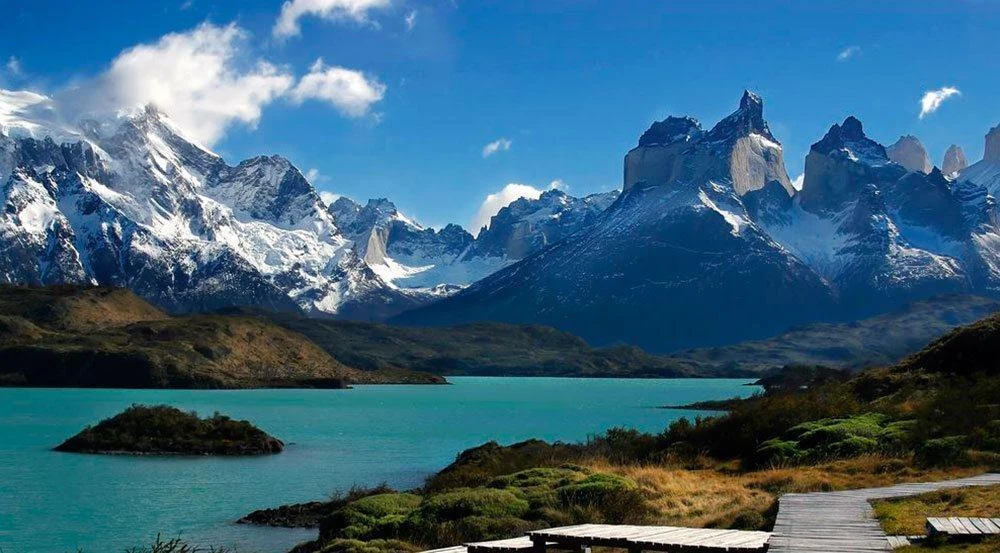
At Torres del Paine, granite peaks, lakes and walking circuits give Patagonia a particular form. A walking-led visit and a quieter landscape stay can begin with the same view and develop into quite different days. The far south is a reason for its own chapter, rather than an extension to be attached casually to a northern route.
Desert and port
In San Pedro de Atacama, the town is a base for desert landscapes, lagoons, geysers and skywatching. Moon Valley, Tatio and the salt-flat country point towards different interests within the northern setting. Desert days and cold nights are part of the contrast. A landscape first encountered through colour and shape becomes a place whose daily rhythm matters too.
Calama is the air gateway, followed by a road leg to San Pedro. That practical distinction belongs near the beginning of a northern journey. Time at the base and time reaching it are different parts of the experience; the desert should have more than the hours left after arrival.
Valparaíso changes the subject. Its port-city hills, elevators and the Alegre and Concepción neighbourhoods invite attention to the built landscape. La Sebastiana adds a cultural address to the city's steep geography. The approach through Santiago and an onward land journey is also different from entering the north through Calama. The two places can be linked deliberately, but one is not a substitute for the other.
The island's wooden story
On Chiloé, stilt houses and wooden churches give timber a leading role. Evergreen forest and a rugged coast surround a settled landscape with a character of its own. After the desert or the port, the change is not simply another view. It is another material, another relationship with water, and another reason to slow the sequence.
The island also has more than one approach: Mocopulli and Castro form one access structure; Puerto Montt, Pargua and a ferry form another. Rain and island roads can affect movement. Those details give a Chiloé stay a different shape from a short mainland city visit, even before any excursions are chosen.
Our Latin America planning guide helps compare Chile's regions without treating the country as one uniform stop. A first journey might stay with the desert and a central-city contrast, or give its time to the southern islands and landscapes. The choice should leave enough room for the place that prompted it. Chile's length supplies possibilities; a memorable route finds its own thread through them.