Destination portrait
Peru
Read the country in stone.
The city beneath the city
In Cusco, one urban story rests on another. The Inca capital developed under Pachacutec; Spanish churches and palaces were later built over its remains. The interest lies in that physical relationship. A wall can hold more than one period, and a street can lead the eye from one building tradition into another. Cusco deserves attention as a city, before it becomes the starting point for a famous sanctuary.
Peru offers several such changes in scale. There is the close work of masonry, the arrangement of a valley, and the larger setting that gives a monument its force. A rewarding journey lets those scales speak to one another instead of asking every day to produce another landmark.
Water, terraces and mountain forest
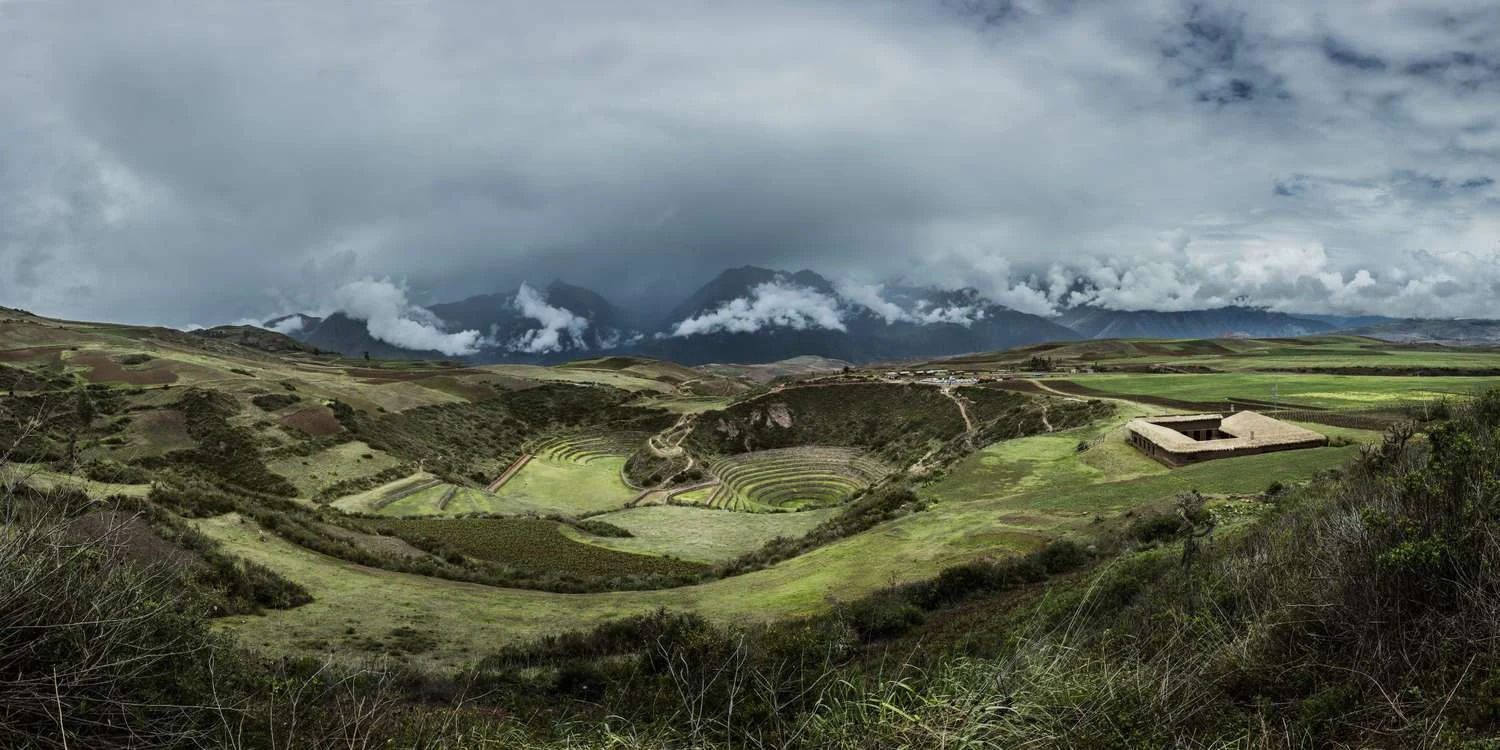
The Sacred Valley is described through the Vilcanota River, the Urubamba mountains, villages and archaeological sites. Maras, Moray, Pisac, Chinchero and Ollantaytambo give the Andean chapter particular places to consider. Their names are more useful as the beginning of an interest than as a list to complete. A visitor drawn to terraces may build a different sequence from someone whose curiosity begins with a town or a woven cultural landscape.
At Machu Picchu, walls and terraces belong to a mountain-forest setting at 2,430 metres. The sanctuary's altitude is one fact about one place, rather than a measure for the whole Peruvian journey. Its setting helps explain why the approach and the time around the visit matter. The landscape is part of the subject, rather than a background to remove from the photograph.
The Qhapaq Ñan road system supplies a wider frame. Communication, trade and infrastructure joined very different terrain. That older network makes an interesting companion to a modern route: connections have a history of their own, as well as a practical use.
Another material, another Peru
In Arequipa, white and pink volcanic sillar gives the historic centre its character. Courtyards, vaults and façades combine European designs with native building techniques. Architecture becomes a closer kind of landscape here, one shaped by material and workmanship. It offers a distinct reason to travel beyond an Andean sanctuary circuit.
Farther towards the coast, the Nasca and Palpa geoglyphs occupy an arid plain south of Lima. Representational figures and geometric lines create another relationship between human marks and a broad setting. Their purposes still invite interpretation; a simple explanation cannot contain every question they raise.
These contrasts make selection worthwhile. A Cusco and Sacred Valley journey already contains several kinds of looking. Arequipa or the coastal desert adds another subject, with an approach of its own. Our regional guide helps give each chapter useful time. Begin with the history or material that draws you, then let the route preserve the difference between a courtyard, a valley and a line across the desert.