
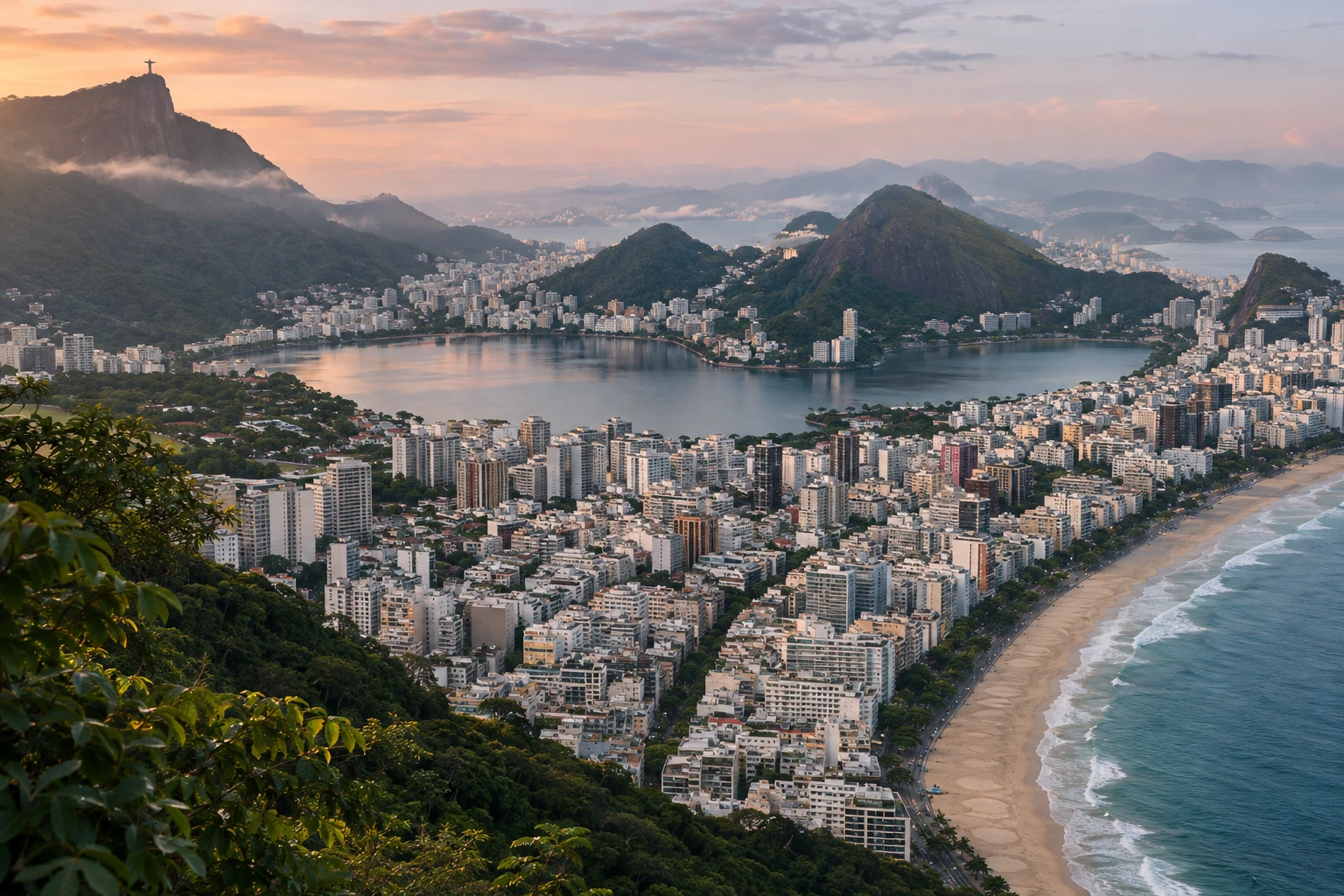
In 1928, Roberto Burle Marx encountered Brazilian tropical plants in the Dahlem glasshouses in Berlin. The young Brazilian was abroad with his family; the episode appears in MoMA’s account of his life and the Brazilian Senate museum’s retrospective. Plants from home became visible in a foreign setting. His later Rio landscapes invite a traveller to notice the city around the room. Choose a Rio hotel through the neighbourhood and the day it supports, then compare the property.
What did Burle Marx bring back to the way Rio looks?
The Senate museum’s account connects the family’s German stay with treatment for Burle Marx’s eyes and his visits to Dahlem’s glasshouses. The glasshouses placed plants from his own country within a different setting. It places a Brazilian landscape designer’s development within an exchange of places and ways of looking. A familiar national landscape could become newly interesting when seen elsewhere.
MoMA’s 1991 exhibition announcement records his return to Brazil in 1930 and a later body of landscape work. The career should not be collapsed into a single glasshouse moment. The plants encountered in Berlin are one stage in a much longer sequence. For the reader choosing a Rio base, the useful insight is that the public setting outside the hotel has its own makers and history, even when it looks inseparable from the city’s natural appeal.
Another stage began with the property now known as Sítio Roberto Burle Marx in western Rio. UNESCO describes a landscape project begun in 1949 and developed over more than forty years, bringing native planting, modernist art and collaboration together. The length of that development matters. A landscape can be experimental and deliberately composed while remaining alive and changing. It is more than a decorative green frame around a building.
Burle Marx’s definition, reproduced in MoMA’s English rendering, gives those decisions a common purpose: A garden is the result of an arrangement of natural materials according to aesthetic laws
. The promenade’s planting and paving can be read as a composed public landscape.
The museum retrospective also records the property’s donation to the federal government in 1985. That later act belongs to the site’s public history. A visitor interested in design can therefore consider a western-Rio landscape experience as a distinct cultural purpose. It should not be assumed to sit at the door of a beachfront hotel simply because both addresses belong to Rio. The itinerary needs to give the visit its own place.
Copacabana brings the designed landscape into the beachfront day. Amy Lifson’s Humanities account for the NEH describes the four-kilometre promenade in black basalt and white limestone and places Burle Marx’s design in 1970. It also recognises the Portuguese paving antecedent. He did not invent the idea of patterned stone underfoot; his work gave an existing tradition a modern urban expression.
That material description changes the way a beachfront stay can be understood. The promenade is not simply the strip between a hotel and a beach. It is a composed public place experienced at walking pace. A traveller drawn to design might give it attention on an ordinary morning rather than treating it only as a route to another appointment. The hotel’s location can support that interest, but the public landscape remains a city experience beyond the property.
The Carioca landscape inscription places designed coastal spaces alongside mountains, restored forest and the Botanical Gardens. It describes relationships that a hotel shortlist can otherwise flatten into one repeated view. A base in one part of the city selects an immediate setting and a pattern of journeys towards the rest. Those differences are reasons to choose thoughtfully, not obstacles to be concealed by a generic Rio description.
The practical inference follows from the historical sequence. Berlin, the western-Rio sítio and the Copacabana promenade are distinct stages in a designer’s work and distinct geographical settings for a visitor. Choose which interests you want the holiday to develop. A room can be beautifully appointed while remaining inconvenient for the days you actually intend to spend. Start with those days, then decide how much of the stay belongs within the hotel itself.
What should decide your Rio neighbourhood?
Your planned days should decide the neighbourhood. Begin with the activities that are fixed, then consider how you want the free hours to feel. A holiday with beach walks and cultural outings asks a different question from a congress that begins early at Riocentro. The accommodation should support that purpose with a practical address and the kind of room that suits the people travelling.
Rio’s geography shapes both its appeal and the daily journey. The Carioca landscape inscription brings together mountains, forest, designed spaces and coast. Those features make the city memorable. They also remind the visitor to read the route between places rather than assuming that two addresses with Rio in their name belong to the same daily routine.
Choose the broad base first, then compare properties within it. If you begin with an isolated room photograph, you may spend the rest of the itinerary accommodating the address. If you begin with the day, the room becomes a place to return to naturally. Our fourteen-day route uses two Rio stays, allowing the opening and closing chapters to serve different interests if desired.
| Base | Useful purpose | Example to investigate |
|---|---|---|
| Copacabana | Beachfront and heritage-hotel interest | Copacabana Palace |
| Ipanema | South Zone beach and design interest | Fasano Rio |
| Barra Olímpica | Riocentro event proximity | Lagune Barra |
| Barra | Hotel-led meeting | Hilton Barra |
A design interest gives a beachfront base one clear purpose: time in the public landscape, with the promenade’s material and historical character part of the experience. A congress gives a different purpose: reaching the right venue at the right time. A hotel-led holiday gives another: spending substantial hours within the property. Write down which purpose comes first, then compare the addresses through that hierarchy rather than through a universal ranking of districts.
Riotur places Ipanema’s beachfront along Avenida Vieira Souto from Arpoador to Jardim de Alah. That is a specific immediate setting to consider, not a promise that every preferred visit is nearby. Ask where the property sits within it and how the daily programme works from that point. The hours without booked transport are part of the stay, and the neighbourhood should contribute something you want from them.
Santa Teresa’s hilltop setting near downtown creates a different possibility, with alleys, stairs and cultural venues. Choose it for the kind of city experience it offers, then ask the practical questions that follow from the actual property and route. A district’s artistic character is not an accessibility assessment, and an attractive view should not replace a clear description of the arrival or the walking involved in the day.
Why choose Copacabana for a beachfront stay?
Choose Copacabana when the beachfront setting belongs at the centre of the visit. Copacabana Palace supplies a particular heritage-hotel example, with an official history that places its opening in 1923. The history adds a layer to the stay, but the current booking still turns on present details: the exact room, occupancy, meal basis and conditions for the dates you want.
A sea-facing room and a room in a beachfront hotel are different descriptions. Ask for the booked category in writing and make sure the view matters enough to justify the choice. The same attention belongs to connecting rooms, bedding and accessibility. A beautiful public space cannot resolve a room arrangement that does not suit the party at night.
Think about how much time you intend to spend in the hotel. A property-led stay can make facilities and room comfort central to the decision. If you expect to leave for most of each day, the address and ease of return may deserve more weight. Neither approach is inherently better. The useful comparison begins with how you actually travel.
Do not make the neighbourhood responsible for every city interest. A beachfront base can still support a cultural programme elsewhere, provided those outings receive proper time. Plan a few purposeful departures and leave enough local hours to enjoy the reason you chose the area. A stay feels more coherent when the immediate setting is part of the experience.
The hotel and promenade also belong to different moments in Copacabana’s development. The 1970 public-landscape design should not be treated as part of the hotel’s original opening story. Keeping the chronology distinct makes the place richer. A visitor can notice how a district changes over time, with a heritage property and a later modernist public space contributing different parts of the present-day experience.
Fairmont Rio Copacabana’s official meeting information gives another current property context at Avenida Atlântica 4240. A traveller attending a meeting there has a more specific location question than someone choosing a general Copacabana holiday. Ask whether the organiser’s accommodation and session arrangements are at the same property, and how any separate arrivals are handled. The neighbourhood name alone cannot answer those booking details.
For a meeting planner comparing the hotel, read the layout-specific table rather than borrowing a headline maximum. The combined Rio de Janeiro I, II and III space lists different theatre, classroom and banquet capacities. The room’s ability to serve a particular event depends on the format. A hotel’s beachfront appeal can support the programme’s atmosphere, but it does not decide whether the required session layout works.
What makes Ipanema a different starting point?
Ipanema provides another South Zone beach base with its own accommodation choices. Fasano Rio stands on Ipanema, with the project attributed to Philippe Starck. For a design-led stay, the project offers a particular reason to investigate the property. A hotel’s creative identity can be part of its appeal without becoming a substitute for understanding the room and location.
Ask what is included in the particular reservation. Breakfast, access to facilities and other services should be read from the booking rather than inferred from a hotel category. If the party includes children or travellers with particular mobility requirements, put those needs into the enquiry before choosing a room. The right answer is a specific arrangement, not a general assurance about luxury.
For a short visit, staying in one neighbourhood can make the city easier to enjoy. Moving hotels uses time for packing and check-in, so a change should have a clear purpose. A longer Brazil route that returns to Rio might use a second address to introduce another emphasis. That choice is useful when it improves the days rather than merely adding another hotel to the experience.
Compare Ipanema and Copacabana through your preferred pattern. How much beachfront time do you want? Which cultural outings are essential? Would you rather return to the same local streets or spend more time within the property? These questions make the comparison personal without requiring a universal neighbourhood ranking.
Imagine a couple with three Ipanema nights and two complete days. One day belongs to a long cultural outing; the other stays close to the beach. The room then has two different roles: somewhere to return after the outing, and a place woven into the slower day. A view may be worth more to someone planning a quiet morning in the room than to a visitor who leaves before breakfast and returns after dark. Compare the room upgrade with the time you would actually spend enjoying it. This turns an attractive room photograph into a choice about your own holiday.
The Ipanema beach setting also has a life outside the property: the tourism account describes recreational use and the stretch between its named endpoints. A visitor can choose a hotel partly to spend time in that setting. Leave some of the day unallocated so the neighbourhood can be experienced without becoming another transfer. If most hours are spent elsewhere, check whether the chosen address still supports the holiday you intend to have.
The western Burle Marx site offers a useful comparison for a traveller interested in design. It is a landscape developed over decades, with a different scale and setting from an Ipanema hotel. Decide whether to make it a separate cultural focus and obtain current visitor arrangements. A thoughtful itinerary can connect design interests across the city while giving each one enough time, rather than implying they are all part of the same immediate neighbourhood.
Returning for a rest, managing separate interests or ending an outing early can matter more than another facility. Decide which of those moments is likely to matter to your party. From each hotel you are considering, trace the afternoon’s route back to the room and the evening’s route out again. That is the address you will actually use.
When should Barra Olímpica take priority?
Barra Olímpica should take priority when the main event programme makes proximity useful. Lagune Barra Hotel positions itself in that area, while Riocentro describes its adjacent hotel alongside convention and exhibition spaces. For a delegate, the ability to organise the morning around the venue can outweigh a preference for a famous beach address.
Hilton Barra’s event offering provides another comparison for a hotel-led meeting. Its published guestrooms and meeting rooms describe the property’s facilities; the proposed event needs a dated allocation and a suitable layout. A traveller booking independently should also ask whether their event has arranged a particular room block or transport plan.
Barra is a choice of daily geography, not a promise that every address in the area is equally convenient. Confirm the hotel’s actual relationship to the event entrance and the way transfers will operate. If the organiser uses shuttles, ask where and when they depart. If you are making separate arrangements, include the return from the final session as well as the morning journey.
Our Rio congress guide develops these decisions for planners. A delegate can use the same principle more simply: stay where the principal commitment works, then give any leisure extension its own time. A weekend after the event may support a different base, with the move treated as part of the extension rather than squeezed between sessions.
Windsor’s Barra convention complex should be assessed through its own distributed spaces and hotels. It is not interchangeable with staying on the Riocentro grounds. A planner considering the complex needs to identify which sessions sit on which floors, where the delegates sleep and how the group moves between them. The useful convenience is the one shown by the actual programme, not by a shared district name.
Barra’s event geography has a wider history in the Olympic masterplan’s event, transition and legacy phases. That background can help explain why the district enters a meeting conversation. It does not establish present transport or hotel convenience for your booking. Use the current venue and accommodation information to choose the base, while allowing the historical geography to add context rather than substitute for a contemporary plan.
How can a beach base include the cultural city?
It can include the cultural city through deliberate outings that allow enough time at the destination. The Museu do Amanhã is one institution with current visitor, accessibility and programme information. Choose the reason for going, check the arrangements and give the visit space in the day. A museum should not become a short stop inserted into an already crowded transfer.
There is a particular reason to look west for a late-2026 cultural stay. In its 16 November announcement, Iphan sets ABERTO 6 at Sítio Roberto Burle Marx for 29 November 2026 to 14 February 2027. More than one hundred works by over sixty artists are announced, with Adriana Varejão, Beatriz Milhazes and Ernesto Neto among the names. The visitor route has four settings: the sculpture garden, residence, Cozinha de Pedra and studio. Contemporary art enters a place already shaped by painting, planting and the daily work of an artist.
Project founder Filipe Assis describes ABERTO’s beginnings in 2022 as an attempt to open architecturally significant places through contemporary art. For this edition, most works were conceived or commissioned for the exhibition, in dialogue with the vegetation, buildings and collections. The date gives a design-led Rio visit a specific subject. A visitor can follow the relationship between an artwork and its setting, rather than ask a garden to serve only as attractive scenery. Give that western-Rio chapter its own route from the chosen hotel.
Ask a guide to develop the interest you care about. If it is urban history, say so. If it is landscape and planting, let that shape the route. A good brief can be brief: one clear interest and a realistic amount of time often produce a better day than a long list of names. Keep a second option available when conditions make the preferred outdoor activity less appealing.
Leave time near the hotel as well. Choosing a neighbourhood creates the possibility of a daily rhythm, and that rhythm needs unallocated hours. A return in the afternoon, a quiet morning or an evening without another departure can make the stay feel more settled. The base earns its place when it supports both the planned experiences and the pauses between them.
A cultural outing in Santa Teresa can develop a different Rio from the beachfront. Its alleys, stairs and arts venues give a guide material for a place-specific day. Ask what the visit is meant to explain and how the chosen route suits the party. A smaller number of meaningful stops can make the district more memorable than a hurried circuit whose only purpose is to include another named neighbourhood.
A stay or event enquiry at Santa Teresa Hotel RJ-MGallery adds a property-level question. The meetings account lists natural light and several social settings, including Bar dos Descasados for private dining or cocktails. Those are possibilities to investigate through the actual brief. They do not establish the entire district’s service or access conditions, and they do not make a dinner booking equivalent to staying at the hotel.
Which hotel details deserve a second look?
Look again at the services most easily assumed. Hilton Barra’s information lists breakfast for a fee and airport shuttles as unavailable. The point extends beyond that property: a room booking does not automatically provide the transport and meals you have imagined around it. Read your rate conditions and arrange any missing components deliberately.
Room access around the flights
Early arrival and late departure need their own decisions. An early room request is not guaranteed access. If the flight pattern makes the room essential before the normal check-in time, ask what must be reserved. For a late flight home, confirm luggage and room options before the last day. These details can have more effect on comfort than another small difference between hotel descriptions.
For families, Ada Tours’ Brazil family guide offers a useful route-level perspective on pace. Bring that perspective into the room enquiry: who sleeps where, how the party returns for rests and which activities can be optional. A family’s needs should shape the accommodation from the start rather than becoming requests added after the category is chosen.
For a congress, use Ada Tours’ logistics discussion to connect the room with the wider arrival and event plan. Ask whether the transfer is individual or shared, which arrivals are covered and what happens outside the main wave. A clear answer makes the hotel booking part of a complete stay.
What might a split stay change?
Consider six Rio nights divided between two purposes: four for an event around Riocentro, then two for a South Zone leisure stay. This is an editorial allocation rather than an account of an actual booking. The first address supports the working programme. The second can place the final two mornings beside a different part of the city. The visitor changes base once to give the leisure chapter its own setting.
Compare that with keeping all six nights at the event-side address. It removes the mid-stay packing and check-in, which may matter to a traveller with a demanding programme. Beach and cultural outings would then begin from that western base. Neither version is inherently more luxurious. One buys continuity in the room; the other changes the relationship between the room and the days outside it. The difference is clearer when the two leisure mornings are drawn into the comparison.
A leisure extension also creates a reason to compare Copacabana with Ipanema through a real interest. A visitor drawn to the promenade and its designed public landscape may prefer one starting point. Someone interested in a particular Ipanema property and its beach setting may choose another. The selected hotel's character and the neighbourhood's daily possibilities can reinforce one another, but they remain two parts of the choice. The most useful room is the one the traveller has time to enjoy, in a place they want to use.
Santa Teresa introduces a third kind of extension: a hilltop district and a property whose social spaces can form part of the stay. It suits a different enquiry from a beachfront room. Arrival, the evening return and any mobility requirements belong alongside the district's cultural appeal. Giving that version a separate place in the comparison preserves its particular geography, instead of treating it as another South Zone beach address.
A visit built around Sítio Roberto Burle Marx would produce another allocation again. The western site has its own landscape and long history of development; it deserves a day chosen for that interest. A split stay is therefore a tool rather than an obligation. It is useful when the second address changes the experience enough to justify the move, and unnecessary when one well-chosen base already supports the days the visitor wants.
How should dates influence the final choice?
Check the city programme and ask the hotel for an offer covering the nights you need. Write down rates, availability and cancellation terms alongside the logistics. If you are considering two dates, request the same room type and services for both so you can see which parts of the offer are tied to the date.
Compare alternatives using the same assumptions. Keep occupancy, room view, meals and cancellation conditions aligned so the price comparison reflects similar stays. If one hotel costs more because it includes something you would otherwise buy, make that difference visible. If another offers a more useful location, count the daily movements it could simplify.
MoMA’s account of the Berlin encounter returns us to the reason for choosing an address thoughtfully. A young Brazilian saw plants from home differently in another country. A traveller in Rio can likewise find that a familiar beach image becomes more interesting when its public landscape and history are understood. Select the hotel that supports the days you want, then leave enough time outside the room to notice the city it belongs to.
What else should you consider?
Which Rio neighbourhood is best for a first leisure stay?
Copacabana and Ipanema are useful beachfront starting points. Choose between actual hotel addresses, room needs and the days you want to spend in the city.
When does Barra Olímpica make sense?
It is relevant when the main commitment is Riocentro or another event in that area. Confirm the exact hotel-to-venue movement.
Is a beachfront hotel room automatically sea-facing?
No. Check the booked category and view. The property’s location and the room’s outlook are separate parts of the reservation.
Should I change hotels during a short Rio stay?
Usually choose one base unless a move serves a clear purpose. Packing and check-in use time that could be spent enjoying the city.
Are breakfast and airport transfers included?
Read the particular booking. Hotels can charge separately for breakfast and may not provide an airport shuttle.
Can a beach base work for cultural visits?
Yes. Give cultural outings their own time and transport plan, then leave local hours to enjoy the neighbourhood where you are staying.
Sources and further reading
Reviewed 18 November 2026
- Family vacation Brazil
- Vetting a Brazil DMC’s Logistics Before You Book a Congress
- Roberto Burle Marx: The Unnatural Art of the Garden
- Burle Marx: o arquiteto-paisagista que se tornou ecologista e colecionador de espécies da flora brasileira
- Sítio Roberto Burle Marx
- Making the Promenade Modern
- UNESCO Carioca landscapes
- Praia de Ipanema
- Santa Teresa Itinerary
- Copacabana Palace official
- Fairmont Rio Copacabana meetings
- Fasano Rio official
- Lagune Barra Hotel
- Riocentro venue operator
- Hilton Barra events
- Windsor Convention Center & Hotels
- AECOM wins master plan design contract for2016Rio Olympic and Paralympic Games
- Museu do Amanhã official
- ABERTO 6 at Sítio Roberto Burle Marx: Iphan announcement (16 November 2026)
- Santa Teresa Hotel RJ-MGallery meetings
- Hilton Barra hotel information